Rameswaram Temple to Dhanushkodi Distance, Route & Places to Visit
 Santosh Balgir
Domestic
Santosh Balgir
Domestic
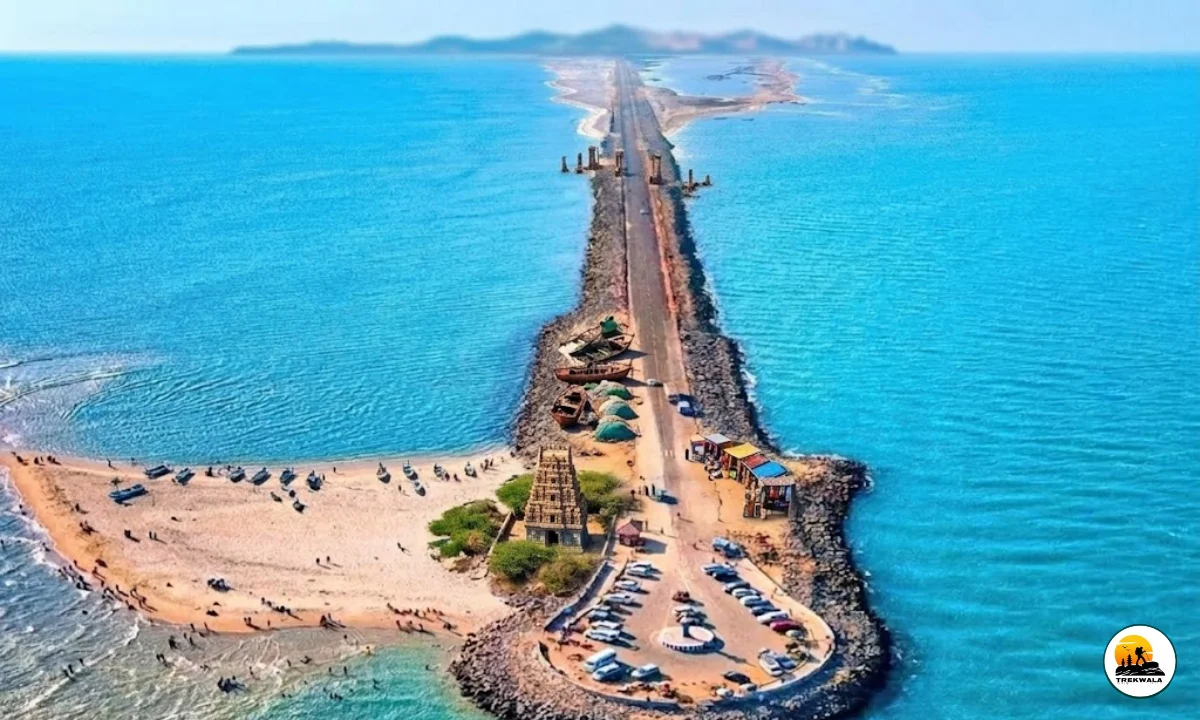
Rameswaram Temple to Dhanushkodi Distance
There are very few drives in India that feel as otherworldly as the road from Rameswaram to Dhanushkodi. The moment you leave the busy temple town behind and head southeast along the narrow strip of Pamban Island, the landscape transforms completely. The road narrows. The ocean appears on both sides. And for stretches of the drive, you feel like you are moving across the water itself with land just barely beneath your wheels.
This 18 to 20 kilometer journey connects one of Hinduism’s most sacred pilgrimage sites to one of India’s most hauntingly beautiful ghost towns. It takes less than an hour. But what you see, feel, and experience along the way stays with you for a very long time.
Rameswaram Temple to Dhanushkodi: Distance and Travel Time
The distance from Ramanathaswamy Temple in Rameswaram to Dhanushkodi is approximately 18 to 20 kilometers by road. The most commonly referenced figure is 19.7 kilometers via the Rameswaram-Dhanushkodi Road, which is also referred to as the Kochi-Dhanushkodi Road or the NH544E extension.
| Starting Point | Destination | Distance | Travel Time |
|---|---|---|---|
| Ramanathaswamy Temple | Dhanushkodi | 18 to 19 km | 28 to 40 minutes |
| Rameswaram Town | Dhanushkodi | 18 to 20 km | 30 to 45 minutes |
| Rameswaram Railway Station | Dhanushkodi | 20 km | 35 to 45 minutes |
Travel time varies depending on vehicle type, how often you stop for photographs, and traffic during peak pilgrimage seasons.
The Drive Itself: What the Road Is Like
The road from Rameswaram to Dhanushkodi is one of the most scenic coastal drives in all of South India. It runs along the narrow spine of Pamban Island with the Bay of Bengal on one side and the Gulf of Mannar on the other. At several points the road appears to float between two stretches of open ocean, which is a genuinely surreal visual experience.
The road is mostly well-maintained in the initial sections. As you approach the ruins and the ghost town, it narrows to a single lane and eventually becomes a sandy coastal track. Private vehicles are permitted up to a designated checkpoint near the ruins. Beyond that point, you need to hire local government-approved jeeps or walk to reach the final tip at Arichal Munai.
The drive is best done in early morning between 6 and 9 AM or in late afternoon between 3 and 5 PM. The light is beautiful for photography at both times, the heat is manageable, and you can potentially catch the sunrise or sunset over the ocean from Dhanushkodi.
How to Travel from Rameswaram Temple to Dhanushkodi
By Taxi or Cab
Hiring a cab or taxi is the most convenient option especially for families, groups, senior citizens, and pilgrims who are combining the Dhanushkodi excursion with their temple visit. Taxis are easily available near Ramanathaswamy Temple, the railway station, and major hotels in Rameswaram.
Most drivers offer round-trip packages with waiting time at Dhanushkodi so you can explore at your own pace without worrying about finding transport back.
Approximate taxi fares for round trip:
| Vehicle Type | Approx Round Trip Fare |
|---|---|
| Hatchback / Small Car | ₹400 to ₹600 |
| Sedan | ₹500 to ₹700 |
| SUV / Innova | ₹700 to ₹1,000 |
| Local Jeep (shared) | ₹150 to ₹200 per person |
Always confirm the fare before starting and clarify waiting time expectations with the driver.
By Bus
Government-operated TNSTC buses run from the Rameswaram bus stand area toward Dhanushkodi roughly every 30 to 45 minutes. The fare is very affordable at around ₹30 to ₹50 one way. The first bus leaves around 8 AM and the last bus from Dhanushkodi returns by 6 PM.
Buses typically go up to the checkpoint near the ruins rather than the final tip at Arichal Munai. From the drop-off point you walk or hire local transport for the last stretch.
The limitation with buses is that you cannot stop along the route for photographs and you are tied to their timing. During peak pilgrim season they can be quite crowded.
By Two-Wheeler
Renting a scooter or motorcycle from Rameswaram is popular among solo travelers and young visitors who want to experience the coastal drive at their own pace. The open road with ocean on both sides is particularly enjoyable on a two-wheeler. Ensure you carry enough water, fill up your fuel before leaving as there are no petrol stations along the Dhanushkodi stretch, and wear sunscreen.
What Is Dhanushkodi? History & Significance
Before listing the places to visit, understanding Dhanushkodi's story makes the visit far more meaningful.
Dhanushkodi sits at the southeastern tip of Pamban Island in Tamil Nadu, just about 24 kilometers from Talaimannar in Sri Lanka. The name translates to Tip of the Bow in Sanskrit and Tamil. According to the Ramayana, Lord Rama pointed the tip of his bow at this very spot to direct his army to begin constructing Ram Setu, the legendary bridge across the ocean to Lanka, to rescue Goddess Sita from Ravana.
The spot where the Bay of Bengal and the Indian Ocean actually meet, called Arichal Munai, is located here. This makes Dhanushkodi both mythologically significant and geographically unique.
But Dhanushkodi also has a tragic modern history. Before December 22, 1964, it was a functioning town. It had a railway station, post office, secondary school, church, and was the main ferry point between India and Sri Lanka. On that night, a catastrophic cyclone struck without warning. Massive tidal waves swept across the narrow island. Approximately 1,800 people died. A passenger train with over 100 people on board was washed away when it was barely one kilometer from Dhanushkodi station. There were no survivors.
After the disaster, the Government of Tamil Nadu declared Dhanushkodi unfit for habitation. The town was never rebuilt. The ruins that remain today are from that single night in 1964. A small community of fishermen has since returned and lives in temporary huts, leaving during monsoon months and returning when the sea is calmer. But the ghost town itself stands frozen in time.
Places to Visit in Dhanushkodi & Along the Route
1) Kothandaramaswamy Temple
Located approximately 13 kilometers from Rameswaram along the Dhanushkodi road, this small temple is one of the very few structures that survived the 1964 cyclone completely intact. That alone makes it remarkable.
The temple is dedicated to Lord Rama and has strong Ramayana connections. According to legend, this is where Vibhishana, the brother of Ravana, surrendered to Lord Rama and sought his refuge after rejecting his brother's evil path. The temple's peaceful atmosphere and its survival of the devastating cyclone give it a very particular sacred energy that pilgrims respond to deeply.
Most jeep and taxi drivers stop here on the way to Dhanushkodi. It is worth spending at least 20 to 30 minutes here.
2) Dhanushkodi Ghost Town Ruins
The ruins of the old town are the most visually striking part of the Dhanushkodi visit. Three tall walls are what remain of the old railway station. These walls standing alone against the sandy beach and open sky create an image that is genuinely unforgettable.
The church ruins are nearby. Decades of salty sea air have given the coral-textured stone walls an appearance unlike any other ruins in India. The remains of the post office, hospital buildings, and scattered house foundations complete the picture of a town that was here and then suddenly was not.
Walking through these ruins is a strange experience. The surrounding landscape is beautiful and the sea is everywhere. But the abandoned structures remind you constantly of what happened here. Many visitors describe it as emotional and reflective rather than merely picturesque.
Small stalls near the settlement sell seashell handicrafts, pearl strings, and snacks. Local women make these crafts and purchasing from them directly supports the fishing community. A few stalls also sell fried fish.
3) Dhanushkodi Beach
The beach at Dhanushkodi stretches approximately 15 kilometers. It is one of the most unspoiled beaches in Tamil Nadu. The sand is white and clean. The water is strikingly clear. On one side of the narrow strip of land is the Gulf of Mannar and on the other is the Bay of Bengal.
Swimming is not recommended due to strong and unpredictable currents. Signboards warn visitors not to enter the water beyond ankle depth. Children especially need to be closely supervised near the shoreline.
Walking along the beach however is peaceful and beautiful. The combination of dramatic ruins, clear turquoise water, and the feeling of being at the very edge of the subcontinent creates an atmosphere that is difficult to find anywhere else.
4) Arichal Munai: The Last Point of India
This is the emotional and visual climax of the Dhanushkodi visit. Arichal Munai is the actual land's end, the tip of Pamban Island and technically the southernmost point of the Indian mainland in this direction. From here you can see the confluence of the Bay of Bengal and the Indian Ocean. The waters look different on each side in terms of color and wave pattern, which is visible to the naked eye on clear days.
For Hindu pilgrims, taking a holy dip in the sea at Arichal Munai is considered highly auspicious. The convergence of two sacred water bodies at the location associated with Ram Setu makes this spot one of the spiritually significant points on the entire pilgrimage.
Beyond the water, on clear days, you can see the chain of limestone shoals stretching toward Sri Lanka. These are the shallow underwater formations believed to be the remnants of Ram Setu. The sight of this chain disappearing into the horizon toward a country that is only 24 kilometers away is remarkable.
Sri Lanka is closer from here than many Indian cities are from each other. The access road to Arichal Munai was constructed only in 2017, making this previously difficult-to-reach point accessible by vehicle. Police stationed here ensure that all visitors leave before dark.
5) New Dhanushkodi Lighthouse
Standing at 53 meters, the lighthouse was built to serve the local fishing community. A visitor gallery provides panoramic views of the surrounding coastline. The views from the top on a clear day are extraordinary, showing the ocean stretching in multiple directions and the narrow strip of land that is Pamban Island.
6) The Floating Stone Temple
Along the beach near the ruins, you may encounter a small makeshift temple with a floating stone kept in a small water tank. The stone is claimed to be from Ram Setu and is presented as evidence of the miracle mentioned in the Ramayana, where monkeys wrote Lord Rama's name on rocks and threw them into the sea, causing them to float miraculously.
Whether you find this theologically compelling or historically questionable, the experience of seeing the stone is interesting. Be aware that the keeper will typically request a donation. Use your own judgment about whether to give.
Practical Tips for the Rameswaram to Dhanushkodi Trip
- Carry water and snacks. There are virtually no shops, restaurants, or ATMs at Dhanushkodi. Small fish stalls and shell craft shops exist near the ruins but do not rely on these for meals or hydration. Have a full meal in Rameswaram before you leave.
- Start early. Leave Rameswaram ideally between 6 and 8 AM. The heat at Dhanushkodi becomes intense by midday. An early start also gives you the best light for photography.
- Return before 6 PM. Dhanushkodi is accessible from 6 AM to 6 PM. Police ensure all visitors leave before dark. The road back in darkness is difficult and local transport availability drops sharply after sunset.
- Wear sunscreen and cover your head. The coastal location means strong sun exposure with constant wind. Sunburn happens faster here than most visitors expect.
- Wear appropriate footwear. Walking on sand is unavoidable and the ruins require walking over uneven ground. Closed shoes are better than sandals, and avoid walking barefoot as broken glass can be hidden under the sand in some areas.
- Do not enter the sea. The currents at Dhanushkodi Beach are genuinely strong. The signboards are not decorative warnings. Wading beyond ankle depth is dangerous.
- Keep cash. Private vehicles go only up to the checkpoint. You will need cash for the local jeep beyond that point.
- No mobile signal. There is no mobile tower coverage in Dhanushkodi village. Inform your family or hotel of your plans before leaving Rameswaram.
Best Time to Visit Dhanushkodi
- October to March is the ideal window. Weather is cooler, seas are calmer, and the drive is comfortable. This is also peak season so expect more people at popular stops.
- April to June is very hot. If visiting in summer, leave Rameswaram no later than 7 AM to beat the worst heat.
- July to September is monsoon season. Strong winds, rough seas, and unpredictable weather can restrict access to the beach areas and Arichal Munai. The small fishing community also leaves Dhanushkodi during these months. It is best to avoid this period.
Suggested Itinerary: Rameswaram and Dhanushkodi in One Day
- Early morning: Darshan at Ramanathaswamy Temple (the 22 sacred wells and the temple corridors deserve proper time, arrive by 5 AM if possible).
- Late morning by around 9 AM: Depart for Dhanushkodi. Stop at Kothandaramaswamy Temple along the way.
- Mid-morning to afternoon: Explore the Dhanushkodi ruins, walk the beach, visit Arichal Munai, take the holy dip if you are a pilgrim.
- Early afternoon: Head back to Rameswaram. Have lunch at one of the many South Indian vegetarian restaurants near the temple.
- The entire excursion including travel time, exploration, and photography takes around 3 to 5 hours comfortably.
My Final Thoughts
The 18 to 20 kilometers between Rameswaram Temple and Dhanushkodi may be one of the shortest distances in India that takes you somewhere this completely different. You begin at a temple that has been a place of Hindu pilgrimage for centuries. You end at the edge of the subcontinent, where two oceans meet, a lost city lies in ruins, and the boundary between India and Sri Lanka is just 24 kilometers of open sea.
Few places anywhere combine spirituality, history, natural beauty, and genuine emotional weight the way Dhanushkodi does. Visit respectfully. Leave only footprints. And carry the memory back with you.




Categories
- Domestic 33
- News 9
- Info 8
- Budget Travel 5
- popular 5
- International 3
- Upcoming 1
Share This Post