Golden Triangle India Itinerary 2026: My Honest Take on Delhi, Agra & Jaipur
 Santosh Balgir
Domestic
Santosh Balgir
Domestic
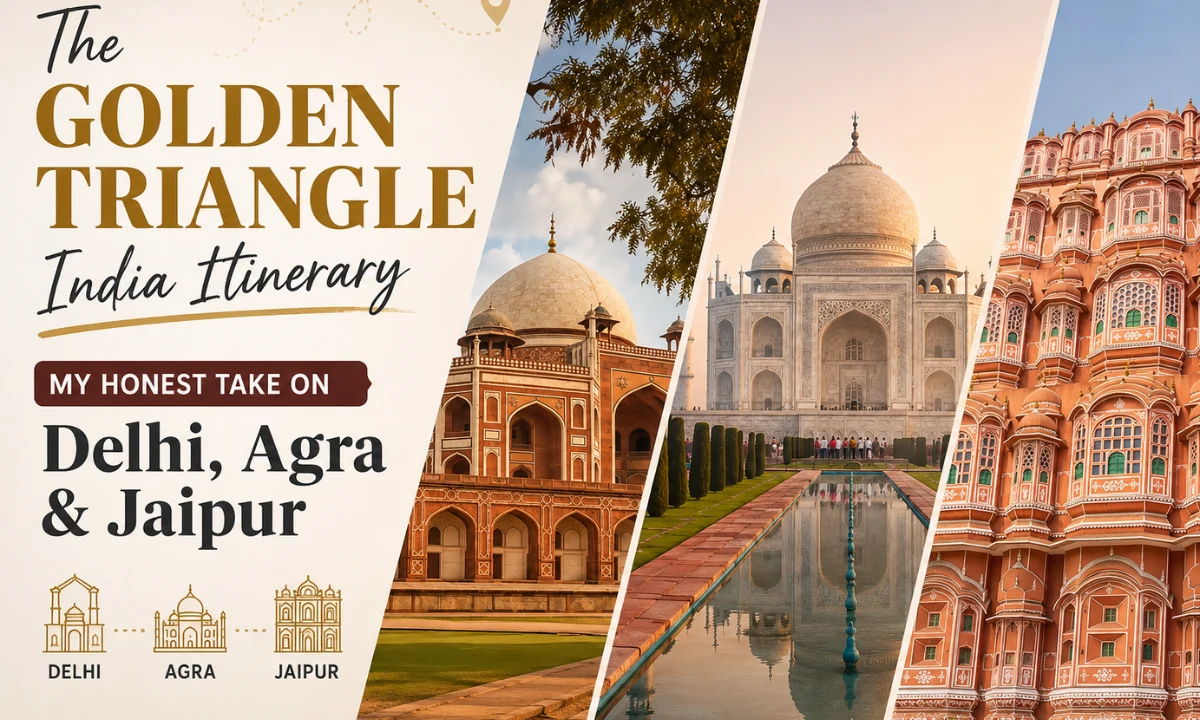
Golden Triangle India Itinerary 2026: My Honest Take on Delhi, Agra & Jaipur
So you are planning your first trip to India & Someone mentioned the “Golden Triangle” that is Delhi, Agra, Jaipur. And you are wondering if it is worth the hype? To be honest yes, it is. But only if you do it in right way. I have done this route three times now (first as a nervous solo traveller then with my trekwala team and later dragging friends and family).
Here is everything I learned the hard way so you do not have to. Let me be clear: this is not another robotic day-by-day itinerary that is present everywhere. This is a real, honest guide from someone who got lost in Chandni Chowk, argued with touts near the Taj, and accidentally ate the best butter chicken of my life in a tiny Jaipur alley.
So let’s Start…
Why the Golden Triangle? (And Why You Should Care)
The Golden Triangle connects India’s capital Delhi, the city of love (Agra), and Rajasthan’s pink-hued capital Jaipur. Roughly 700 kilometres total. You can rush through it in 4 days, but please don’t. Give yourself at least 6-7 days. This is not a checklist. This is about soaking in the chaos, the colours, the smells, and the stories.
How Many Days Do You Really Need?
- 4 days: You will see monuments but feel nothing. You will be exhausted and spend half your time in a car.
- 5-6 days: This is the sweet spot. You get a taste of each city without rushing.
- 7+ days: Ideal. You can add a day trip, take a cooking class, or just wander.
My recommendation: 7 days. Here is how I would spend them.
My 7-Day Golden Triangle Itinerary (With Real Talk)
Day 1 – Arrive in Delhi. Do Not Try to See Everything.
You land in Delhi. You are jet-lagged, overwhelmed by the humidity, and your ears are ringing from the constant honking. Do not fight it. Embrace it.
What I actually did: After checking into my hotel in Paharganj (budget area near New Delhi Railway Station – convenient but chaotic), I took a deep breath and stepped out. I hired an auto-rickshaw for the afternoon. Cost me around ₹500 for a few hours.
What you should see on Day 1 (half-day only):
- India Gate – Go in the late afternoon. It is just a war memorial, but the vibe is great. Families picnicking, kids flying kites. Grab a corn-on-the-cob from a street vendor (₹20-30). Do not overthink hygiene here – it is part of the experience.
- Humayun’s Tomb – This is basically the “practice Taj Mahal”. Built decades before the Taj, it has the same Mughal architecture but way fewer crowds. Entry ₹35 for Indians, ₹600 for foreigners (carry cash – card machines often “down”). Go around 4 PM for golden light.
Where I ate dinner: Karim’s near Jama Masjid. Legendary Mughlai food since 1913. The mutton burra and chicken stew are insane. Cost per person ~₹500. Be prepared for a loud, no-frills setting. Totally worth it.
Pro tip: Do not bother with Red Fort on day one. It is massive and will exhaust you. Save it.
Day 2 – Old Delhi vs New Delhi (Yes, They Are Two Different Worlds)
Morning: Old Delhi. Afternoon: New Delhi. This contrast is what makes Delhi fascinating.
Morning – Old Delhi (The Chaos You Came For):
- Start at Jama Masjid (India’s largest mosque). Arrive by 7:30 AM to avoid crowds. Climb the southern minaret for ₹100 – you get a bird’s eye view of the sea of humanity below. Women must cover head (robes provided free).
- Then, walk to Chandni Chowk. But do not just walk – take a cycle rickshaw ride through the narrow lanes. Negotiate hard: ₹200 for a 20-30 minute ride. You will pass through spice markets, wedding card lanes, and the famous Paranthe Wali Gali (alley of stuffed flatbreads). Eat a paratha here (₹80-120). They are dripping in ghee. Do not even think about calories.
Afternoon – New Delhi (The Calm After the Storm):
- Qutub Minar – A 73-metre brick minaret from the 12th century. The ruins around it are beautiful. Spend an hour. Entry ₹35/₹600.
- Lotus Temple – Shaped like a lotus flower, Bahai temple, free entry. Closed on Mondays. Peaceful. You can sit inside in silence for 10 minutes. Nice break from the chaos.
Evening: I skipped Red Fort because I was tired. But if you have energy, the Sound & Light Show at Red Fort (₹80) is decent. Or just eat. I went to Gulati Restaurant in Pandara Market – their butter chicken is award-winning. Cost ~₹1000 per person.
Travel mistake I made: I tried to do too much. Do not. Pick 3-4 things max per day.
Day 3 – Drive to Agra. Stop at the “Ghost City”.
Distance: Delhi to Agra is 210 km. Takes 3-4 hours by car. Train is faster (2 hours) but less flexible. I recommend hiring a private car for the whole Golden Triangle. Cost about ₹8,000-10,000 for the entire circuit (shared with 2-3 people). Book through your hotel – it is safer than random online deals.
- En-route stop: Sikandra – Akbar’s tomb. Most tourists skip it. Do not. The red sandstone mausoleum is stunning and virtually empty. Entry ₹35. Spend 30 minutes.
- Arrive in Agra by lunch. Check into hotel. I stayed at Hotel Taj Plaza – basic but clean, 5-minute walk from Taj Mahal’s east gate. Cost ~₹2000 per night.
- Late afternoon: Mehtab Bagh – This is the garden behind the Taj Mahal, across the Yamuna River. Go around 5 PM for sunset views. You get the classic reflection shot without the crowds. Entry ₹35. Bring mosquito repellent.
Dinner tip: Do not eat at tourist-trap rooftop restaurants with “Taj view”. They overcharge for mediocre food. Instead, walk 10 minutes into the local market. Try Dasaprakash for South Indian or Mama Chicken Mama Franky for rolls.
Day 4 – Taj Mahal at Sunrise. Then Agra Fort.
This is the day you wake up at 5 AM. Yes, it hurts. But I promise you, watching the Taj Mahal turn from grey to pink to gold as the sun rises is worth every lost minute of sleep.
The Taj Mahal experience:
- Gates open at sunrise (around 6:15 AM in winter, 5:45 AM in summer). Reach the East Gate by 5:45 AM. You will already find a queue.
- Ticket: ₹50 for Indians (plus ₹200 “tourism tax” – yes, it is confusing), ₹1300 for foreigners. Buy online at tajmahal.gov.in to skip queues.
- What you cannot take inside: tripods, chargers, power banks, food (except water). There is a locker room, but it gets crowded.
- The main mausoleum gets packed by 8 AM. See it first, then explore the gardens.
- Hidden gem: Walk to the back of the complex, near the river. Fewer people, better photos.
After breakfast (around 10 AM): Agra Fort. It is a 15-minute drive from the Taj. Another red sandstone fort, but very different from Delhi’s Red Fort. Emperor Shah Jahan was imprisoned here by his son, spending his last days gazing at the Taj Mahal from a small balcony. That story alone makes it worth it. Entry ₹35/₹600. Spend 2 hours.
Afternoon option: Itimad-ud-Daulah (Baby Taj) – a small but intricately carved marble tomb. Less crowded. Lovely for an hour. Entry ₹35.
What I skipped: Fatehpur Sikri on the same day. Do not rush. Leave it for day 5.
Day 5 – Agra to Jaipur. Fatehpur Sikri and a Stepwell Stop.
Check out of Agra hotel by 8 AM. Drive to Jaipur (240 km, 5-6 hours). Break the journey.
Stop 1 – Fatehpur Sikri (1 hour from Agra): A deserted Mughal capital built by Emperor Akbar, abandoned after 15 years because of water shortage. The Buland Darwaza (Victory Gate) is 54 metres high – one of the largest gateways in the world. Free entry. Park at the bottom and take a shared bus up (₹30) to avoid touts. Spend 1.5 hours.
Stop 2 – Abhaneri Stepwell (2 hours from Fatehpur Sikri): This was my favourite hidden gem. A 9th-century stepwell with 3,500 steps going down 20 metres. It looks like an ancient swimming pool. Free entry. There is a small Harshat Mata temple next to it. Absolutely Instagram-worthy. Spend 30 minutes.
Arrive Jaipur by evening. I stayed at Shahpura House – a heritage hotel that makes you feel like royalty. Rooms start at ₹4000. Worth every rupee.
Dinner: Chokhi Dhani – an ethnic village resort 30 minutes from city centre. ₹900 per person all-you-can-eat Rajasthani thali, plus puppet shows, camel rides, folk dancers. Very touristy, but also very fun. Go once.
Day 6 – Jaipur: Amber Fort, City Palace & Hawa Mahal
Jaipur is called the Pink City because its old buildings were painted terracotta pink in 1876 to welcome the Prince of Wales. The colour has faded, but the charm hasn’t.
Morning (beat the heat): Amer Fort (also called Amber Fort). It is 11 km from city centre. Go by 8 AM. You can drive up or take a jeep (₹200 return). The Sheesh Mahal (Mirror Palace) inside is breathtaking – tiny mirrors reflect a single flame into thousands. Elephants carry tourists up the ramp, but I suggest walking (20 minutes). Entry ₹100 for Indians, ₹550 for foreigners.
Mid-morning: Jal Mahal – the Water Palace. You cannot go inside. Just stop for photos from the road. Looks magical during monsoon when the lake is full.
Afternoon: City Palace – still the residence of Jaipur’s royal family. The Peacock Gate (four different-coloured doors) is famous. Entry ₹200/₹700. Museum inside has royal costumes and weapons.
Late afternoon: Hawa Mahal (Palace of Winds) – five-storey facade with 953 small windows. Built so royal women could watch street festivals without being seen. You can go inside (₹50/₹200), but honestly the best view is from the street opposite.
Evening: Jantar Mantar – a UNESCO-listed observatory with giant stone astronomical instruments. Sounds boring, but the 27-metre sundial is impressive. Entry ₹35/₹200.
Shopping: Johari Bazaar for jewellery, Bapu Bazaar for textiles. Bargain ruthlessly – start at 30% of the quoted price. And do not forget to buy lac bangles (₹50-100) – women wear them stacked up to the elbow.
Day 7 – Relaxed Morning, Then Back to Delhi
If you have time before your flight, visit Galtaji Temple (Monkey Temple) – an ancient Hindu pilgrimage site with natural springs and hundreds of monkeys. Free entry. It is 20 minutes from city centre. The monkeys are cheeky – hold your sunglasses.
Alternatively, take a cooking class in Jaipur. I did one at Spice Court (₹2500 for 4 hours). Learned to make dal baati churma. Still use the recipe at home. Drive back to Delhi (5 hours) or take a flight (1 hour, ₹3500-5000). Fly out of Delhi in the evening.
Practical Tips That Will Save Your Trip
Getting Between Cities:
- Car with driver: Most comfortable and flexible for 2-4 people. Cost ~₹10,000-12,000 for the whole 6-7 day circuit (fuel, tolls, driver’s accommodation included). Your hotel can arrange.
- Train: Cheaper (₹500-1500 per person for AC chair car). But you have to book weeks in advance on irctc.co.in. Also, you cannot stop at Fatehpur Sikri or Abhaneri.
- Bus: Cheapest but least comfortable. Avoid.
Best Time to Go: October to March. I went in February – perfect weather (20-25°C daytime). April to June is brutally hot (45°C). July to September is monsoon – lush but humid, and Taj can be foggy.
Scams to Watch For:
- “This road is closed, let me take you to a different shop.” Classic. Ignore and keep walking.
- At Taj Mahal, touts will say “official guide” and charge ₹2000. Real official guides stand near the ticket counter with ID cards. Cost ₹600 for 2 hours.
- Auto-rickshaw drivers will take you to “government handicraft emporiums” where they get commission. Say “no shopping” firmly at the start.
Packing Essentials:
- Earplugs (India is loud)
- Scarf/shawl (for covering head at religious sites)
- Sturdy walking shoes (you will walk 10-15 km per day)
- Reusable water bottle (buy bottled water – tap water is not safe)
- Immodium (just in case. Street food is amazing, but your stomach may revolt)
Money: Carry cash (₹1000-2000 per day). Small shops, rickshaws, and entry fees often do not take cards. ATMs are everywhere but sometimes run out of cash on weekends.
Budget Breakdown (For 7 Days, Moderate Traveler)
- Accommodation: ₹2000-4000 per night × 6 nights = ₹12,000-24,000
- Food: ₹800-1500 per day = ₹5,600-10,500
- Transport (private car shared with 2 others): ₹4,000-5,000 per person
- Monument entry fees (including Taj): ₹3,000-4,000 for foreigners, ₹1,000-1,500 for Indians
- Misc (shopping, tips, snacks): ₹3,000-5,000
Total: ₹30,000-50,000 per person (approx $350-600). Foreign tourists pay much higher monument fees – budget accordingly.
The One Thing I Would Do Differently
I rushed. On my first Golden Triangle trip, I tried to tick boxes. By day three, I was exhausted and everything looked like “another damn fort”. On my second trip, I slowed down. I sat on a bench at Humayun’s Tomb for an hour just watching birds. I ate chaat at a random Delhi street stall without checking Google reviews (it was delicious). I hired a local guide in Jaipur who told me stories about his grandmother.
India is not a place to conquer. It is a place to experience. The Golden Triangle is the perfect introduction – but only if you let it breathe.
So here is my final advice: take this itinerary, use it as a skeleton, and then ignore half of it. Get lost. Talk to strangers. Eat the food that scares you a little. You will come back with stories that no guidebook can give you. Safe travels. And if you see a guy selling chai near the Taj Mahal’s east gate, buy one for me.



Categories
- Domestic 33
- News 9
- Info 8
- Budget Travel 5
- popular 5
- International 3
- Upcoming 1
Share This Post