Air India International Route Rationalisation: New DGCA Refund Rules for May 2026
 Santosh Balgir
News
Santosh Balgir
News
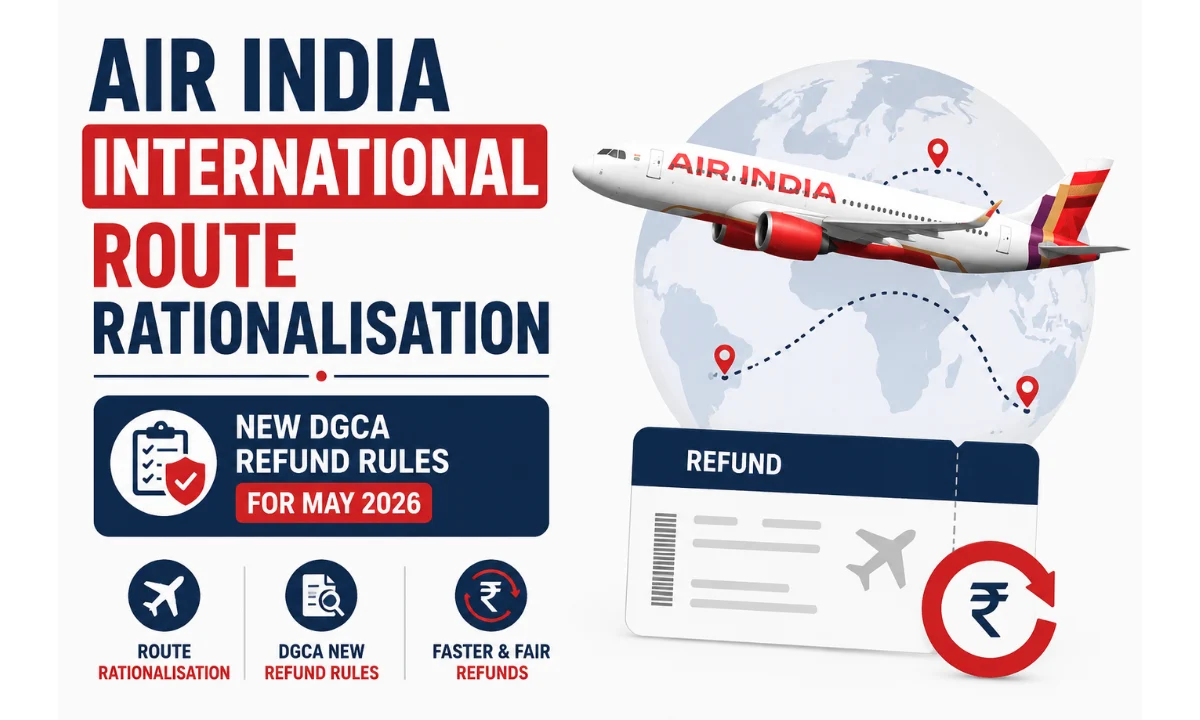
Air India International Route Rationalisation
The summer of 2026 has delivered a brutal blow to Indian air travellers. A combination of geopolitical strife, record-breaking jet fuel prices, and systemic operational pressures is causing one of the most significant waves of flight cancellations in recent history.
Major carriers like Air India, IndiGo, and SpiceJet are slashing schedules, suspending international routes for months, and disrupting flights across the domestic network. The situation is chaotic, but the Indian aviation regulator, the Directorate General of Civil Aviation (DGCA), has handed passengers a powerful shield: a comprehensive overhaul of cancellation and refund rules that came into effect just a few months ago, in March 2026.
This article is your essential playbook. We break down exactly what is happening, your enforceable rights, the immediate steps to take when a flight is axed, and the smartest strategies to safeguard your money and your travel plans.
What’s Actually Happening Right Now (May 2026)
The headlines are dominated by Air India, which announced a major rationalisation of its international network. The airline is reducing or temporarily suspending dozens of flights on key routes to North America, Europe, Australia, and Asia between June and August 2026—a period that is typically its strongest revenue window. The reasons cited are “record-high jet fuel prices” and “continued airspace restrictions” arising from global conflicts, including the West Asia crisis.
The cuts are substantial. Routes that have been temporarily suspended include Delhi-Chicago, Mumbai-New York (JFK), Delhi-Shanghai, and Delhi-Newark. On other key routes, frequencies are being slashed: Delhi-San Francisco is dropping from 10 to 7 weekly flights, and Delhi-Toronto will be halved from 10 to 5 weekly through July.
The Fuel Crunch: The financial strain driving these decisions is acute. Average jet fuel prices soared to $162.89 per barrel for the week ending May 8, 2026, up sharply from $99.40 at the end of February.
The Domestic Disruption: It’s not just international travel. Operational strain is evident on domestic routes as well. Reports indicate that both IndiGo and SpiceJet have experienced simultaneous disruptions across multiple hubs in May, affecting key domestic corridors. IndiGo and SpiceJet have cancelled a number of flights across major cities, including Delhi, Bengaluru, Kolkata, and Mumbai, impacting routes to destinations like Srinagar, Jaipur, and others.
Beware the Fake News: Amidst this real turbulence, a wave of misinformation has spread widely on social media, falsely claiming that Air India has cancelled all its international flights until July due to a fuel shortage. The airline has officially and repeatedly refuted this, calling it “fabricated” and “malicious”. While the situation is serious, a complete shutdown is not the reality. The key takeaway is this: if your booking is on an affected route, the airline is obligated to contact you.
Your Legal Rights When an Indian Airline Cancels Your Flight
The DGCA has fundamentally rewritten the rules of engagement for flight cancellations. The revised Civil Aviation Requirements (CAR), effective March 26, 2026, are clear, binding, and designed to protect you.
Here’s what you are entitled to when an airline cancels your flight:
| Your Right | Details | Timeline |
|---|---|---|
| Full Refund or Rebooking | You have the choice: accept a full cash refund for the base fare, fuel surcharge, and all taxes OR accept free rebooking on an alternate flight. Airlines cannot force you to take a voucher. | Refund: 7 working days for credit cards; 14 working days for agent bookings |
| Meals & Refreshments | If a cancellation results in a delay of more than 2 hours, the airline must provide you with free meals and refreshments. | Immediate |
| Hotel Accommodation | For overnight cancellations, the airline is responsible for providing you with free hotel accommodation and round-trip transfers. | Immediate |
| Cash Refund for Cash Payments | If you bought your ticket with cash, your refund must be processed immediately at the airline’s local office. | Immediate |
| Reimbursement of Statutory Taxes | Even for “non-refundable” tickets that you cancel, the airline must refund the statutory taxes like User Development Fee (UDF), Airport Development Fee (ADF), and Passenger Service Fee (PSF). | Same as above |
| Compensation (in certain cases) | In specific instances of flight cancellation (within two weeks of departure), you may also be entitled to monetary compensation ranging from ₹5,000 to ₹10,000, depending on the route length. | N/A |
Crucial Protections Under the New Rules:
- No More “Credit Shells” by Default: This is perhaps the most important change. Under the new rules, a cash refund is your default right. Airlines cannot automatically issue you a credit shell or voucher. They must obtain your explicit consent to convert the refund to credit.
- Airline is Always Responsible: Even if you booked your flight through a travel agent or an online travel portal, the airline is legally responsible for processing your refund. If your agent is giving you the runaround, go directly to the airline.
- The 48-Hour “Look-In” Period: A new rule allows you to cancel or amend tickets booked on an airline’s own website without any charge, provided you do so within 48 hours of making the booking. This is a great safety net for early bookings.
5 Immediate Steps When Your Flight Gets Cancelled
Don’t panic. Follow this action plan to secure your rights and minimise your loss:
- Document Everything. Screenshot your original booking confirmation, the cancellation SMS or email, the airline’s current schedule for your route, and any offers made at the airport. This is your evidence for any future complaint or dispute.
- Assert Your Right to a Cash Refund. When you speak to the airline, do not accept a travel voucher unless you genuinely want one. State clearly: “Under the new DGCA rules effective March 26, 2026, I am requesting a full cash refund to my original payment method.”
- File Your Refund Request. Do it through the airline’s official website or app first. This creates a clear, trackable paper trail. If you booked through an agent, file with the airline and simultaneously contact your agent. Remember, the airline is ultimately responsible.
- Know Your On-Site Rights. If the cancellation happens at the airport, request meals for delays over 2 hours and, for overnight cancellations, demand hotel accommodation and transfers. These are mandatory care obligations, not optional favours from the airline.
- Escalate If They Stall. Keep a close watch on the clock. If the 7-day (credit card) or 14-day (agent booking) deadline passes without your refund, escalate immediately. File a complaint on the AirSewa portal (airsewa.gov.in), the government’s aviation grievance platform. If the airline continues to be non-compliant, your next step is the District Consumer Forum, as aviation disputes fall under the purview of the Consumer Protection Act of 2019.
The 3 Smartest Ways to Protect Yourself Before Booking
With the current instability, proactive planning is your best defence. Here’s how to minimise your financial exposure:
- Book Refundable Fares for Uncertain Travel
If you are booking for a visa-dependent trip, a crucial business meeting, or any plan with genuine uncertainty, the “Flexi” or refundable fare is your best bet. You typically pay ₹800–2,500 more upfront, but you gain the peace of mind to cancel with minimal penalty. The penalty for cancelling a Flexi fare 30+ days out is often just ₹1,500–3,000. - Buy Standalone Travel Insurance
This is a non-negotiable for international travel and a wise choice for domestic trips. A good travel insurance policy (costing as little as ₹200–500 per trip for domestic travel) covers you for situations that airline policies often do not: medical emergencies, illness, natural disasters, and trip interruption. For fixed-date leisure trips where you are 90% certain of your plans, a Saver fare plus separate insurance is usually cheaper and more comprehensive than a flexible flight fare. For international trips, verify that your policy covers trip cancellation due to visa rejection. - Use a Premium Credit Card with Trip Protection
Several premium credit cards in India now come with built-in trip cancellation insurance as a key benefit. Cards like the HDFC Infinia, Amex Platinum, or IDFC FIRST Bank’s Ashva Metal card offer coverage for non-refundable flight and hotel bookings of up to ₹25,000, twice a year. For frequent flyers who already hold these cards, this is a hassle-free layer of protection that can be used in situations where airline policies don’t apply.
My Final Words On Flight Cancellations
The wave of flight cancellations in 2026 is real and disruptive, but your position as a passenger is significantly stronger than it was just a few months ago. The DGCA’s March 2026 rules have given you clear, enforceable rights: guaranteed cash refunds, strict payout deadlines, and a 48-hour grace period for early cancellations. Airlines cannot bully you into taking vouchers, and they cannot hide behind third-party agents.
Your job is simple: know your rights before you need them. Document everything from the moment disruption strikes. Escalate without hesitation when an airline misses a deadline. By being informed and assertive, you can navigate this summer of travel turbulence with confidence and protect both your money and your peace of mind.

Categories
- Domestic 33
- News 9
- Info 8
- Budget Travel 5
- popular 5
- International 3
- Upcoming 1
Share This Post