Jallianwala Bagh Distance From Golden Temple: Complete Walking Guide 2026
 Santosh Balgir
Domestic
Santosh Balgir
Domestic
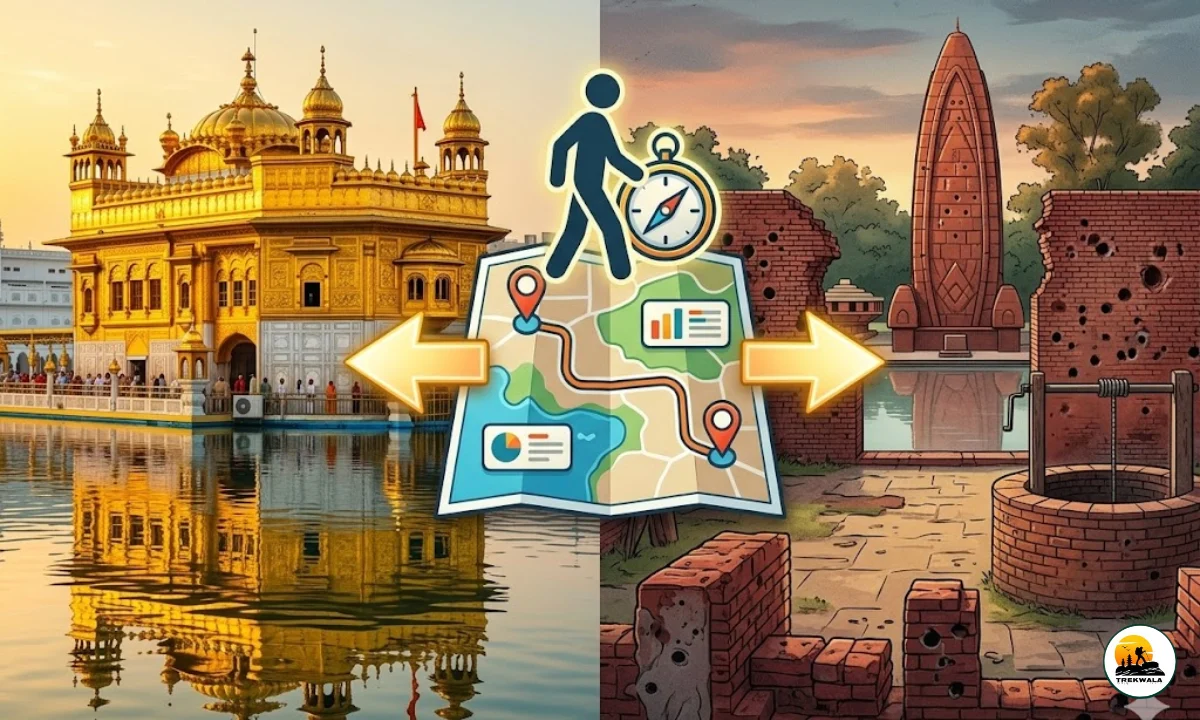
Jallianwala Bagh Distance from Golden Temple
You are standing at the Golden Temple in Amritsar. The golden dome shines above you. The Amrit Sarovar pool glows in the morning light. You have just finished your darshan and maybe shared a meal at the langar. Now you want to visit Jallianwala Bagh. But how far is it? Can you walk? Should you take a taxi?
Here is the simple answer. Jallianwala Bagh is approximately 500 to 800 meters from the Golden Temple complex. That is a walking distance of 5 to 10 minutes. Some visitors say it takes as little as 2 to 5 minutes depending on which exit you take from the Golden Temple.
The two sites are essentially adjacent to each other. One source incorrectly lists the distance as 88 kilometers. That is completely wrong. Do not believe it. All reliable travel sites, maps, and thousands of visitor reports confirm the distance is under 1 kilometer.
In 2026, the Golden Temple and Jallianwala Bagh remain the two most visited sites in Amritsar. They are almost always visited together, often on the same morning. The proximity allows visitors to move from a place of spiritual peace to a place of historical reflection within minutes. This guide covers the exact distance, walking routes, timings, what to see at both sites, and practical tips for your visit.
Exact Distance and Travel Time from Golden Temple to Jallianwala Bagh
Here is the detailed breakdown of how far Jallianwala Bagh is from the Golden Temple using different modes of transport.
| Mode of Transport | Distance | Time Required | Best For |
|---|---|---|---|
| Walking (via Heritage Street) | 500-800 meters | 5-10 minutes | Most visitors, pilgrims, budget travelers |
| Walking (direct route from Golden Temple exit) | 400-500 meters | 2-5 minutes | Those exiting from the nearest gate |
| Auto-rickshaw / Tuk-tuk | 800 meters | 3-5 minutes | Elderly travelers, families with young children, hot weather |
| Private car / Cab | 800 meters to 1 km | 5-7 minutes | Large groups, those with mobility issues |
| Cycle rickshaw | 800 meters | 5-8 minutes | Short rides, experiencing old city lanes |
The walking route is the preferred choice for almost everyone. The path is flat, well-marked, and passes through Heritage Street, which has been developed into a pleasant pedestrian zone with shops and food stalls. You do not need a vehicle for such a short distance. In fact, taking a vehicle can sometimes be slower because the lanes near the Golden Temple are narrow and crowded, especially during peak hours and festival days.
What visitors say on social media: Recent tweets and travel posts consistently praise the convenience. One user wrote: “Golden Temple to Jallianwala Bagh is literally a 2 minute walk. You cannot miss it. Go to Golden Temple first, then walk straight to the Bagh.” Another posted: “Most people, when they visit Amritsar, end up visiting only Golden Temple and Jallianwala Bagh because they are so close together.” This proximity makes it easy to cover both sites in a single morning.
Important note about the incorrect distance: Some outdated websites or sources may list the distance as 88 kilometers or more. That is an error. Those sources may be confusing Amritsar with another city or referring to a different location entirely. Ignore those numbers. The actual distance is under 1 kilometer. You can verify this on Google Maps or any reliable travel guide.
Walking Route: Step-by-Step Directions
Here is the simplest walking route from the Golden Temple to Jallianwala Bagh.
| Step | Direction | Landmark | Approximate Walking Time |
|---|---|---|---|
| 1 | Exit the Golden Temple complex from the main entrance (Clock Tower side) | Golden Temple Clock Tower (Ghanta Ghar) | 1 minute |
| 2 | Walk straight onto Heritage Street | Heritage Street pedestrian zone | 1 minute |
| 3 | Continue straight for approximately 300-400 meters | Shops, food stalls, vendors on both sides | 3-4 minutes |
| 4 | Look for the Jallianwala Bagh entrance on your left | Large gate with signage, often with a small crowd | 1 minute |
| 5 | Enter the memorial | Ticket counter (nominal fee or free) | 1 minute |
The route is incredibly straightforward. You cannot get lost. Heritage Street is the main pedestrian walkway connecting the Golden Temple to the surrounding market area. Jallianwala Bagh is located just off this street. The entrance is hard to miss because there is usually a small queue of visitors and some vendors selling water bottles and snacks outside.
Alternative route: If you exit the Golden Temple from a different gate (such as the one near the langar hall), you may need to walk an additional 2-3 minutes to reach Heritage Street. The total walking distance will still be under 10 minutes. Ask any local for directions. Everyone knows where Jallianwala Bagh is.
Best time to walk: Early morning (6:00 AM to 8:00 AM) is ideal. The streets are less crowded, the temperature is cooler, and both sites are quieter. Late afternoon (4:00 PM to 6:00 PM) is also good, especially if you want to see the Golden Temple at sunset and then visit the Bagh before it closes.
Golden Temple (Sri Harmandir Sahib): Quick Overview
Before you walk to Jallianwala Bagh, you will likely visit the Golden Temple. Here are the key details every visitor should know.
| Detail | Information |
|---|---|
| Full Name | Sri Harmandir Sahib (also called Darbar Sahib) |
| Nickname | Golden Temple (due to gold foil covering the sanctum) |
| Founded By | Guru Ram Das (fourth Sikh Guru) in 1577 |
| Sarovar (Pool) | Amrit Sarovar (meaning “Pool of Nectar”) – built by Guru Ram Das in 1577 |
| Main Sanctum Built | 1589 (foundation stone laid by Sai Mian Mir, a Muslim Pir from Lahore) |
| Guru Granth Sahib Installed | 1604 by Guru Arjan Dev |
| Gold Foil Added | 1830 by Maharaja Ranjit Singh |
| Open To | Everyone, regardless of caste, religion, or social status |
| Langar (Community Kitchen) | Serves free food 24×7 to 15,000+ people per day |
| Key Attractions | Akal Takht (main seat of Sikhism), Dukh Bhanjani Beri (sacred tree), Clock Tower |
The Golden Temple is not just a tourist attraction. It is the holiest site in Sikhism. The name “Golden Temple” comes from the gold foil that covers the main sanctum. But the original name, Harmandir Sahib, means “everyone’s (Har) temple (mandir).” This reflects the Sikh principle that everyone is welcome, regardless of background.
The spiritual experience: Even if you are not Sikh, the atmosphere inside the Golden Temple complex is deeply moving. The live singing of prayers (kirtan) echoes across the sarovar. Volunteers sweep the floors and serve food with genuine humility. The water of the Amrit Sarovar is considered sacred. Many visitors sit by the pool for an hour or more, simply absorbing the peace.
Practical tips for Golden Temple: Cover your head with a scarf or cloth before entering. Remove your shoes at the designated areas. Wash your feet in the small pools provided at the entrance. Do not carry cigarettes, alcohol, or non-vegetarian food into the complex. Photography is allowed in most areas but not inside the main sanctum. The queues to enter the main sanctum can take 45 minutes to 1 hour during peak times. Go early morning to avoid the rush.
Jallianwala Bagh: History and Significance
Jallianwala Bagh is not a garden in the traditional sense. It is a memorial garden built on the site of one of the most tragic events in India’s struggle for independence.
| Detail | Information |
|---|---|
| Date of Massacre | April 13, 1919 (Baisakhi day) |
| Responsible Officer | Brigadier-General Reginald Dyer |
| British Troop Size | 150 soldiers |
| Official British Casualty Count | 379 dead, 1,500 wounded |
| Actual Estimated Casualties | Much higher (many deaths went unrecorded, bodies removed at night) |
| Memorial Established | 1951 (inaugurated by Dr. Rajendra Prasad, first President of India) |
| Memorial Designer | Benjamin Polk (American architect) |
| Key Features | Bullet-marked walls, Martyrs’ Well, Eternal Flame, Martyrs’ Gallery |
| Entry Fee | Minimal or free (small fee for foreigners in some seasons) |
| Opening Hours | 6:00 AM to 7:00 PM (summer), 7:00 AM to 6:00 PM (winter) |
What happened on April 13, 1919? On that day, a large crowd had gathered in Jallianwala Bagh to celebrate Baisakhi, the Sikh festival marking the founding of the Khalsa Panth by Guru Gobind Singh in 1699. Many villagers had come to Amritsar for the festival. They were peaceful. There was no violent protest happening at that moment.
Brigadier-General Reginald Dyer arrived with 150 troops. Without warning, he ordered them to open fire on the crowd. The Bagh had only one narrow entrance. Dyer placed his soldiers at that entrance. People could not escape. They jumped into a well inside the garden to avoid the bullets. Many drowned. The firing continued for approximately 10 minutes. When the shooting stopped, hundreds were dead. Dyer later stated that his goal was to “produce a moral effect” on the population.
The memorial today: The Jallianwala Bagh memorial was established in 1951. A 30-foot high pillar (pylon) stands in the middle of a shallow tank. Stone lanterns on four sides are carved with the Ashok Chakra. The words “In memory of martyrs, 13 April 1919” are inscribed on all four sides of the pylon. An eternal flame (never-extinguishing lamp) burns at the entrance to honor the dead. The bullet marks are still visible on the walls. The well into which people jumped has been preserved. A Martyrs’ Gallery displays portraits of freedom fighters. A light and sound show recreates the events of 1919 every evening.
What to See at Jallianwala Bagh
Here are the specific things you should look for when you visit Jallianwala Bagh.
| Attraction | Description | Emotional Impact |
|---|---|---|
| Martyrs’ Well (Shaheed Kuan) | The well where hundreds jumped to escape bullets. Many drowned. Now enclosed with a protective grille. | Very high. One of the most somber spots in the memorial. |
| Bullet Marks on Walls | Original bullet marks preserved on the side walls. Some walls still show hundreds of impact points. | High. A visual reminder of the violence. |
| Eternal Flame (Amar Jyoti) | A lamp that burns continuously at the entrance to honor the martyrs. | High. Represents undying memory of the dead. |
| Memorial Pylon | 30-foot high stone pillar with Ashok Chakra lanterns. Inaugurated in 1951. | Moderate. The central architectural feature of the memorial. |
| Martyrs’ Gallery | Indoor gallery with portraits and stories of freedom fighters from Punjab. | Moderate. Educational, helps understand the broader independence movement. |
| Firing Point Marker | A marked spot showing where General Dyer positioned his soldiers to fire. | High. Helps visitors understand how trapped the crowd was. |
| Light and Sound Show | Evening show (after sunset) recreating the 1919 events. Narrated by actor Amitabh Bachchan’s voice. | High. Stirring experience, but check timings before visiting. |
The Martyrs’ Well is the most emotionally difficult part of the visit. When you stand at the well and imagine people jumping in to escape bullets, only to drown in the water below, the tragedy becomes real. Many visitors pause here in silence. Some leave flowers or prayers. The bullet marks on the walls are also striking. They are not faded. They are clearly visible, even after more than 100 years.
Visitor feedback on social media: Recent tweets and travel posts describe the experience as “soul-stirring” and “a must for understanding India’s freedom struggle.” One visitor wrote: “I knew about Jallianwala Bagh from history books. But standing there, seeing the bullet marks and the well, I cried. You cannot understand what happened until you stand there.” Another post noted: “The contrast is powerful. Golden Temple is peace and hope. Jallianwala Bagh is tragedy and sacrifice. They are so close, but the emotions are worlds apart.”
Criticism from some visitors: A few recent visitors (including some NRIs) have expressed concern that the Bagh has become “too commercialized” or “theme park-like” with crowds and vendors. They wish for a more solemn atmosphere. Others have praised the maintenance and the efforts to keep history alive. If you want a quieter experience, visit early morning right when it opens. Avoid weekends and holidays.
Combined Golden Temple and Jallianwala Bagh Itinerary
Here is a sample half-day itinerary that covers both sites comfortably.
| Time | Activity | Location | Notes |
|---|---|---|---|
| 5:30 AM | Wake up and get ready | Your hotel | Wear modest clothing, carry head covering |
| 6:00 AM | Arrive at Golden Temple | Golden Temple complex | Early morning = fewer crowds, cooler weather |
| 6:00 AM – 7:30 AM | Golden Temple darshan, sit by sarovar, visit Akal Takht | Golden Temple complex | If queues are long, do parikarma (circumambulation) first |
| 7:30 AM – 8:00 AM | Langar breakfast (free meal) | Guru Ramdas Langar hall | Sit on floor, eat with everyone. A beautiful experience. |
| 8:00 AM – 8:10 AM | Walk to Jallianwala Bagh | Heritage Street | 5-10 minute walk. Buy water if needed. |
| 8:10 AM – 9:00 AM | Visit Jallianwala Bagh memorial | Jallianwala Bagh | See bullet marks, well, eternal flame, gallery |
| 9:00 AM – 9:15 AM | Walk back towards Golden Temple | Heritage Street | Browse shops if interested |
| 9:15 AM onwards | Explore Heritage Street, shop, eat kulcha and lassi | Heritage Street / nearby markets | Breakfast options available |
This itinerary works for most visitors. You see both sites, experience the langar, and still have the rest of the day for other attractions like the Partition Museum, Gobindgarh Fort, or the Wagah Border ceremony. If you have more time, consider staying for the evening light and sound show at Jallianwala Bagh.
If you only have 2 hours total: Spend 1 hour at Golden Temple (focus on the main sanctum and the sarovar), then 30 minutes at Jallianwala Bagh, then 30 minutes walking back and forth. It is rushed but possible.
If you want a deeper experience: Spend 3-4 hours at Golden Temple. Attend the Prakash ceremony (morning ritual where Guru Granth Sahib is brought to the main sanctum). Sit by the sarovar for an hour. Eat langar slowly. Then visit Jallianwala Bagh for 1-2 hours, including the Martyrs’ Gallery and a quiet moment at the well.
Opening Hours and Best Time to Visit
Timings can vary slightly by season. Here are the general hours.
| Site | Summer Timing (Apr-Sep) | Winter Timing (Oct-Mar) | Notes |
|---|---|---|---|
| Golden Temple | Open 24 hours | Open 24 hours | Main sanctum closes briefly for cleaning but complex always open |
| Golden Temple Main Sanctum | 4:00 AM to 11:00 PM approx | 4:00 AM to 10:00 PM approx | Queues form early |
| Prakash Ceremony (morning) | Around 4:00 AM | Around 5:00 AM | Guru Granth Sahib brought to sanctum |
| Sukhasan Ceremony (night) | Around 10:00 PM | Around 9:00 PM | Guru Granth Sahib returned to Akal Takht |
| Jallianwala Bagh | 6:00 AM to 7:00 PM | 7:00 AM to 6:00 PM | Open all week |
| Martyrs’ Gallery | 9:00 AM to 5:00 PM | 10:00 AM to 4:00 PM | Closed on some national holidays |
| Light and Sound Show | After sunset (timings vary) | After sunset (timings vary) | Check at entrance for exact showtime |
The Golden Temple is technically open 24 hours. But the main sanctum (where the Guru Granth Sahib is seated) has specific hours. If you want to go inside the sanctum, visit between 4:00 AM and 10:00 PM. The early morning hours (4:00 AM to 6:00 AM) are the most peaceful. The langar runs 24 hours, though the main meal services are scheduled at specific times.
Best time to visit Jallianwala Bagh: Early morning (as soon as it opens) or late afternoon (after 4:00 PM). The midday sun can be intense, especially in summer. There is limited shade inside the Bagh. The light and sound show in the evening is highly recommended by many visitors. But check the timing at the entrance, as it changes with sunset.
Best season to visit Amritsar: October to March. The weather is pleasant. Daytime temperatures range from 15°C to 25°C (59°F to 77°F). Summer (April to June) is very hot, often exceeding 40°C (104°F). Monsoon (July to September) brings humidity and occasional heavy rain.
Frequently Asked Questions (Golden Temple to Jallianwala Bagh)
Q: Is Jallianwala Bagh walking distance from Golden Temple?
Answer: Yes. It is approximately 500-800 meters away. A 5-10 minute walk. Some exits from the Golden Temple complex are even closer (2-5 minutes).
Q: Can I visit both Golden Temple and Jallianwala Bagh in one morning?
Answer: Yes comfortably. Most visitors spend 2-3 hours at Golden Temple (including darshan, langar, and sitting by the sarovar) and 45-60 minutes at Jallianwala Bagh.
Q: Is there an entry fee for Jallianwala Bagh?
Answer: For Indian citizens, the fee is minimal (often ₹10-20 or free on some days). For foreign tourists, the fee is higher (approximately ₹100-200). Check at the entrance.
Q: Are there guides available at Jallianwala Bagh?
Answer: Yes. Official and unofficial guides are available near the entrance. They charge ₹100-300 for a 30-45 minute tour. Some are very knowledgeable. Others are less reliable.
Q: Can I take photos inside Jallianwala Bagh?
A: Yes. Photography is allowed in most areas. Be respectful. Do not take selfies at the well or the bullet-marked walls. Some visitors find that distasteful.
Q: Is there parking near Golden Temple and Jallianwala Bagh?
Answer: Limited. Paid parking lots are available a 10-15 minute walk away. The lanes near the temple are narrow and often closed to private vehicles.
Common Mistakes Visitors Make (And How to Avoid Them)
| Mistake | Consequence | How to Avoid |
|---|---|---|
| Visiting Jallianwala Bagh first | Misses the emotional contrast (peace then tragedy) | Visit Golden Temple first, then walk to the Bagh |
| Going in midday summer | Heat exhaustion, no shade at Bagh | Visit early morning (6-8 AM) or late afternoon |
| Wearing inappropriate clothing | Denied entry to Golden Temple | Cover head, cover legs and shoulders, remove shoes |
| Carrying large bags | Tiring, not allowed in some areas | Leave bags at hotel or use cloakroom near Golden Temple |
| Forgetting water | Dehydration, especially in summer | Buy water from shops on Heritage Street |
| Taking selfies at the well | Disrespectful, annoys other visitors | Keep phone away. Observe in silence. |
| Believing the 88 km distance myth | Confusion, wasted time planning | Trust verified sources. Distance is under 1 km. |
| Not checking Jallianwala Bagh closing time | Arriving after gates close, missing the visit | Check timings before you go. Close at 6-7 PM depending on season. |
The most common mistake is visiting Jallianwala Bagh first. The emotional journey works better when you go from peace (Golden Temple) to tragedy (Jallianwala Bagh). The contrast helps you understand why the massacre was so devastating. A peaceful gathering of people, similar to the crowds at the Golden Temple, was fired upon without warning. Starting at the Bagh first loses that contrast.
The 88 km myth: This error appears on some less-reliable travel sites. It may have started as a typo or confusion with another location. Ignore it. The actual distance is walking distance. You can verify this on Google Maps in 30 seconds.
Nearby Attractions (Within Walking Distance)
After visiting the Golden Temple and Jallianwala Bagh, here are other nearby sites you can explore on foot.
| Attraction | Distance from Golden Temple | Walking Time | Description |
|---|---|---|---|
| Partition Museum | 500 meters | 5-7 minutes | Preserves personal stories, letters, and artefacts from 1947 Partition |
| Heritage Street | 0 meters (starts at temple entrance) | 1 minute | Pedestrianized shopping and food street |
| Akal Takht | Inside Golden Temple complex | 0 minutes | Main seat of Sikhism, where edicts are issued |
| Central Sikh Museum | Inside Golden Temple complex | 0 minutes | History of Sikhism and Sikh martyrs |
| Guru Ka Bagh | 1.5 km | 15-20 minutes | Historical garden associated with Guru Tegh Bahadur |
| Durgiana Temple | 2 km | 20-25 minutes | Hindu temple resembling the Golden Temple architecture |
The Partition Museum is highly recommended if you have an extra hour. It opened in 2017 and has collected thousands of personal stories from survivors of the 1947 Partition. The museum is located in the Town Hall building on Heritage Street. Entry fee is minimal. Many visitors cry while reading the personal accounts. It is a powerful complement to Jallianwala Bagh because both sites deal with trauma and loss.
Heritage Street: This is the main pedestrian walkway connecting the Golden Temple to the rest of the city. It was redeveloped in recent years and is now clean, well-lit, and lined with shops selling everything from religious items to Punjabi juttis (traditional shoes) to street food. You will walk through it anyway on your way from the temple to Jallianwala Bagh. Take your time.
Wagah Border: This is not within walking distance. It is approximately 30 kilometers from the Golden Temple. You will need a car or taxi (45-60 minutes). The flag-lowering ceremony happens every evening. Many visitors combine Golden Temple + Jallianwala Bagh in the morning and Wagah Border in the late afternoon.
Food to Try Near Golden Temple and Jallianwala Bagh
Amritsar is famous for its food. Here are some must-try items within walking distance of both sites.
| Food Item | Where to Find | Best Time | Approximate Price |
|---|---|---|---|
| Langar (free meal) | Golden Temple langar hall | Morning or afternoon | Free (donations welcome) |
| Amritsari Kulcha (stuffed bread) | Kesar da Dhaba, Bhai Kulwant Singh Kulchian Wale | Breakfast or lunch | ₹40-80 per kulcha |
| Lassi (sweet yogurt drink) | Any local sweet shop on Heritage Street | Afternoon | ₹30-60 per glass |
| Jalebi (sweet spiral fritter) | Heritage Street vendor | Morning or evening | ₹20-40 per plate |
| Chole Bhature (chickpea curry with fried bread) | Near Golden Temple entrance | Breakfast | ₹50-100 per plate |
| Pindi Chana (spicy chickpeas) | Kesar da Dhaba | Lunch | ₹80-150 per plate |
| Gajar ka Halwa (carrot dessert) | Winter season only | Evening | ₹50-100 per serving |
The langar at the Golden Temple is not just free food. It is a spiritual experience. Volunteers cook, serve, and clean. Everyone sits on the floor together. There is no distinction between rich and poor, high caste and low caste. If you visit Amritsar, eating at the langar is as important as seeing the temple. The food is simple: dal (lentils), sabzi (vegetable), roti (bread), rice, and kheer (rice pudding) on special days. It is not fancy. But it is made with devotion.
Amritsari Kulcha: This is the signature dish of Amritsar. A kulcha is a stuffed bread baked in a clay oven (tandoor). The stuffing is usually aloo (potato) and pyaz (onion). It is served with chole (chickpea curry) and chutney. Bhai Kulwant Singh Kulchian Wale is famous and located near the Golden Temple area. Go early. The queues are long.
Lassi: Amritsar lassi is thick, creamy, and served in tall metal glasses. It is more like a meal than a drink. Some lassis are topped with malai (cream). Do not order one if you are in a hurry. You will need time to finish it.
Practical Tips for Your Visit
| Tip | Details |
|---|---|
| Carry a head covering | Required for Golden Temple. Scarf or dupatta works. Men can use a handkerchief. |
| Remove shoes before entering temple | Shoe storage available (small fee). Or carry in a bag. |
| Wash feet at designated areas | Small pools of water at temple entrance. Step in, wash, step out. |
| Dress modestly | Cover shoulders and legs. Avoid shorts, sleeveless tops, mini skirts. |
| Carry water | Especially in summer. Buy from shops on Heritage Street. |
| Keep your phone charged | For photos and navigation. But silence phones inside both sites. |
| Be respectful of silence | Jallianwala Bagh is a memorial. Speak quietly. No loud music or videos. |
| Visit early morning | 6:00 AM to 8:00 AM is the best window. Fewer crowds, better weather. |
| Combine with Wagah Border | Same day possible if you start early. But check Wagah Border timing. |
| Wear comfortable walking shoes | You will walk 3-5 kilometers total between the sites and surrounding streets. |
The head covering rule is strictly enforced at the Golden Temple. You will see racks of scarves available for borrowing at the entrance if you forget yours. But it is better to bring your own. The shoe storage is safe but can be slow during peak hours. Some visitors prefer to carry their shoes in a small bag. That saves time waiting in line.
Silence at Jallianwala Bagh: This is important. The Bagh is not a park. It is a memorial to hundreds of people who died violently. Taking selfies at the well or making loud jokes is disrespectful. If you see other visitors doing this, politely ignore them. Maintain your own solemnity. The experience will stay with you longer if you approach it with respect.


Categories
- Domestic 33
- News 9
- Info 8
- Budget Travel 5
- popular 5
- International 3
- Upcoming 1
Share This Post