Nagarkot City Places To Visit: Complete Travel Guide for 2026
 Santosh Balgir
Domestic
Santosh Balgir
Domestic
Nagarkot City Places To Visit
Imagine waking up before dawn. You wrap yourself in a warm jacket. You climb a short hill. And then you see it. The sun rises behind the Himalayas. The snow-capped peaks turn from silver to gold to orange. Mount Everest itself appears on the horizon. That is Nagarkot.
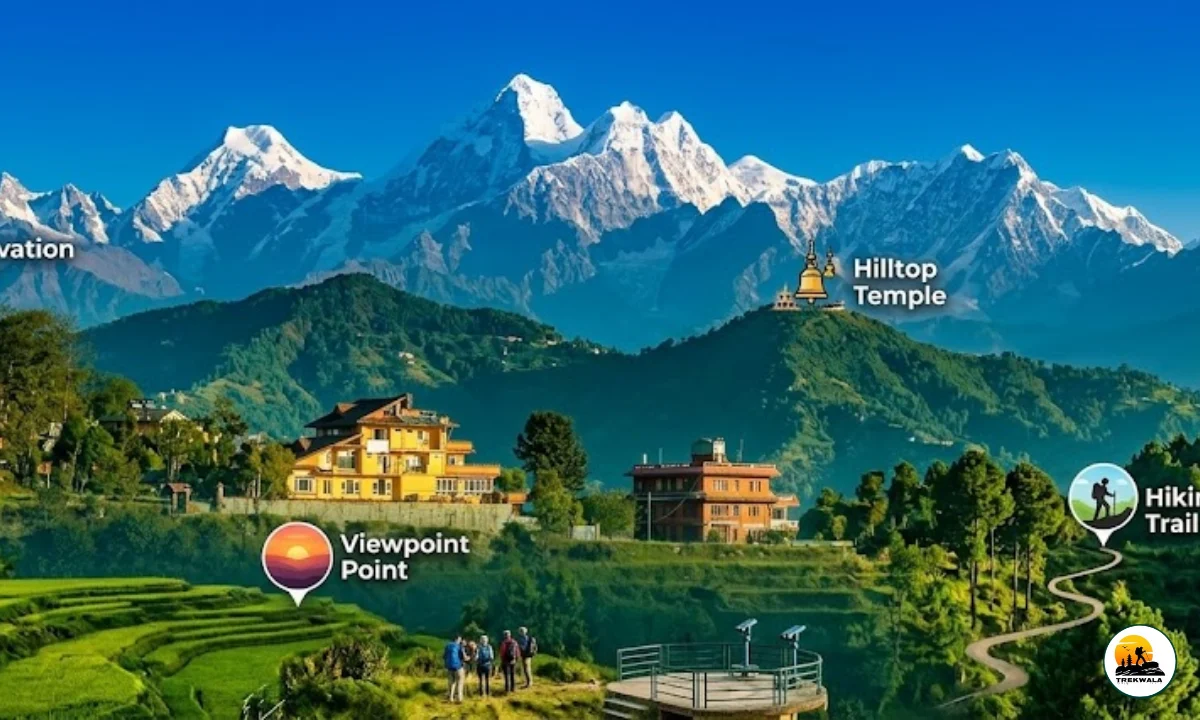
Nagarkot is a hill station located about 32 kilometers east of Kathmandu, Nepal, at an elevation of 2,175 to 2,195 meters above sea level. It is not a city in the traditional sense. It is a peaceful village perched on a ridge with one of the most spectacular mountain views on earth. On clear days, you can see eight Himalayan ranges including Annapurna, Manaslu, Ganesh Himal, Langtang, Rolwaling, Numbur, Mahalangur (which includes Everest), and Jugal.
What makes Nagarkot special is accessibility. You do not need to trek for weeks to see these mountains. You can drive 1.5 to 2 hours from Kathmandu and be there. In 2026, Nagarkot has seen a record surge in visitors, especially for the first sunrise of the Nepali New Year. It is now ranked among Nepal’s top rising destinations for both domestic and international tourists.
Nagarkot View Tower (Geodic Tower) – The Star Attraction
The Nagarkot View Tower, also called the Geodic Tower or Lookout Tower, is the single most important destination in Nagarkot. It offers 360-degree panoramic views of the Himalayas and is considered the best sunrise viewpoint in the region.
| Detail | Information |
|---|---|
| Location | Eastern end of Nagarkot ridge |
| Elevation | Approximately 2,195 meters |
| Distance from Nagarkot center | 3 km (1 hour easy walk or short taxi ride) |
| Best time to visit | Sunrise (5:00 AM to 6:30 AM depending on season) |
| What you can see | Everest, Langtang, Ganesh Himal, Dorje Lakpa, Annapurna (on clearest days) |
| Entry fee | Small fee (typically NPR 100-200 for foreigners) |
| Facilities | Steel staircase to upper platform, small tea shop nearby |
The View Tower is not fancy. It is a functional steel structure with a staircase that takes you to an elevated platform. But that platform changes your life. On a clear morning, you will see the sun hit Everest first. The peak turns bright orange while the valleys below remain dark.
Within 20 minutes, the entire Himalayan arc is glowing. Visitors on social media describe this moment as “magical” and “a feeling I cannot put into words.” One recent post said: “Sunrise from Nagarkot feels like the mountains are waking up with you.”
Practical advice: Arrive at the tower at least 30 minutes before sunrise. The color show starts before the sun appears. Bring binoculars. The mountains are distant, and binoculars help you pick out Everest from the other peaks. Wear warm clothes. Even in spring, the morning temperature at 2,195 meters can drop to near freezing. And check the weather forecast before you go. If clouds are predicted, the sunrise may be hidden. Many visitors make the mistake of going on a cloudy day and leaving disappointed. Check visibility reports online or ask your hotel.
Nagarkot Panoramic Hiking Trail
The Nagarkot Panoramic Hiking Trail is a 12-kilometer loop that connects the viewpoints, villages, and forests around Nagarkot. It is famous for rewarding views of the Himalayas, countryside, villages, and rice terraces.
| Detail | Information |
|---|---|
| Total length | 12 kilometers (complete loop) |
| Time required | 3 to 4 hours (moderate pace) |
| Difficulty | Easy to moderate (some gentle inclines, no steep climbing) |
| Starting point | Usually from Nagarkot town center or Danda Gaon |
| Includes | Nagarkot Nature Trail + Tamang Village Walk + forest sections |
| Best season | Spring (March-May) and Autumn (September-November) |
| What you see | Pine forests, terraced farms, local villages, mountain views throughout |
The Panoramic Trail is perfect for travelers who want to experience Himalayan nature without breaking a sweat. You are not climbing a mountain. You are walking along a ridge with constant mountain views. The trail passes through pine forests that smell incredible in the morning. It goes past traditional Tamang villages where you can see daily life unchanged for generations. And it connects to the View Tower as one of its high points.
What hikers say: Recent visitors on travel forums praise the trail for being “beautiful countryside” and “a peaceful escape from Kathmandu noise.” One reviewer wrote: “I am not a trekker. I cannot walk 6 hours uphill. But the Panoramic Trail was perfect. Two hours of walking, stunning views, and tea shops along the way.”
Practical advice: Start the trail early, right after sunrise. The morning light on the mountains is best between 6:00 AM and 9:00 AM. Carry water and snacks. There are small tea shops along the route, but they may not be open very early. Wear sturdy walking shoes. The trail is not paved. After rain, sections can be muddy. And hire a local guide if you are unsure about the route. The trail is generally well-marked, but some connecting paths can be confusing for first-time visitors.
Nagarkot Nature Trail
The Nagarkot Nature Trail is the first half of the larger Panoramic Hiking Trail. It is a 6-kilometer leisure walk that runs through coniferous forest with tall pines overlooking rolling valleys, villages, and terraced rice farms.
| Detail | Information |
|---|---|
| Length | 6 kilometers |
| Time required | 1.5 to 2 hours |
| Difficulty | Easy (less steep than the full Panoramic Trail) |
| Starting point | Danda Gaon |
| Ending point | Kartike Village |
| Terrain | Forest paths, some village sections, gentle slopes |
The Nature Trail is ideal for families, older travelers, or anyone who wants a shorter walk. The pine forest is dense and quiet. You will hear birds and maybe see some small wildlife. The trail is less crowded than the View Tower area because many tourists skip the walk. That means you get moments of complete silence with only the wind in the trees.
Practical advice: Do this walk in the late afternoon if you miss the morning. The sunset light through the pine trees creates beautiful photography conditions. Carry insect repellent if you are visiting in summer. The forest has mosquitoes and other small insects. And tell someone at your hotel where you are going. The trail is safe, but mobile phone reception can be spotty in the forest sections.
Nagarkot Buddha Peace Park Hiking Trail
Buddha Peace Park is a green space with gardens, hiking paths, and a large golden Buddha statue. The trail to the park is an 8-kilometer leisure hike from Nagarkot town through pine jungles, viewpoints, and terraced plantations.
| Detail | Information |
|---|---|
| Trail length | 8 kilometers (round trip from Nagarkot) |
| Time required | 2 to 3 hours |
| Park elevation | Similar to Nagarkot (approx 2,150 meters) |
| Main attraction | Giant golden Buddha statue in “Bhumisparsha Mudra” (earth-touching gesture) |
| Facilities | Manicured gardens, benches, meditation areas |
| Best for | Relaxation, photography, quiet reflection |
The Buddha Peace Park is different from the View Tower. The View Tower is about dramatic mountain scenery. The Peace Park is about calm. The golden Buddha sits in manicured gardens with flower beds and walking paths. You can sit on a bench, look at the mountains, and just breathe. Locals come here for morning meditation. Visitors come here to decompress after the sunrise crowds.
What visitors admire: Recent reviews on travel sites mention “bird watching” and “feeding the birds” as highlights. One visitor wrote: “Was wonderful visiting this temple. Nice place to relax with the beauty of bird watching, people feeding them.” This is not a rushed tourist stop. It is a place to slow down.
Practical advice: Bring a small amount of bird food if you want to feed the local birds. The birds are accustomed to visitors and will eat from your hand. Go in the late morning after the sunrise crowds have left. You will have the park almost to yourself. And combine this with the Nature Trail on the same day. The walk to the park passes through similar forest and village scenery.
Changu Narayan Temple (Nearby UNESCO Site)
Changu Narayan Temple is not in Nagarkot, but it is the most common combination with a Nagarkot visit. It is an ancient Hindu temple perched on a high hill, surrounded by champak tree forest and a small village. It is a UNESCO World Heritage Site.
| Detail | Information |
|---|---|
| Distance from Nagarkot | 8 km (approximately) |
| Travel time | 30 minutes by car or 2-3 hours on foot (hiking trail) |
| Age of temple | Over 3,000 years old (built by King Mandev) |
| UNESCO status | World Heritage Site |
| Architectural style | Pagoda style with exquisite wood, stone, and metal crafts |
| Main deity | Lord Vishnu (in his Changu Narayan form) |
| Entry fee | Small fee for foreigners (approx NPR 300-500) |
The hike from Nagarkot to Changu Narayan is one of the most popular day walks in the Kathmandu Valley. You walk downhill through forests and villages, with mountain views behind you. Then you arrive at the temple, which is one of the oldest in Nepal. The stone carvings and wooden struts are masterpieces of ancient craftsmanship. And the village around the temple is charming, with traditional houses and small shops.
What travelers say: On social media, the Nagarkot-to-Changu-Narayan hike gets consistent 5-star reviews. One post said: “The hike down is easy. The temple is incredible. And you can take a taxi back to Kathmandu from the temple parking lot.” Another wrote: “Combining Nagarkot sunrise with Changu Narayan is the perfect one-day itinerary from Kathmandu.”
Practical advice: Do the hike downhill from Nagarkot to Changu Narayan, not uphill. The elevation drop is significant. Walking uphill from the temple to Nagarkot is much harder. Start at Nagarkot after sunrise, walk for 2-3 hours, explore the temple, then take a taxi or local bus back to your starting point. Hire a guide for the hike if you want historical context at the temple. The trail is easy to follow, but a guide can explain the carvings and legends.
Rani Jhula (Suspension Bridge)
Rani Jhula is a 250-meter suspension bridge located a short walk from the main Nagarkot road. It is a less-known spot that offers good views and a mild adventure experience.
| Detail | Information |
|---|---|
| Location | Short walk from main Nagarkot road (15-20 minute walk with incline) |
| Length | 250 meters |
| Type | Suspension bridge over a river gorge |
| Best for | Photography, mild thrill, off-the-beaten-path experience |
| Difficulty of access | Moderate incline walk from the road |
Commentary: Rani Jhula is not on most tourist itineraries. That is exactly why you should go. The bridge sways slightly when you walk across it. The river below is far down. And the surrounding hills are green and quiet. One traveler on Tripadvisor described it as a “short walk from the main road about 15-20 minutes with a good incline.” That incline keeps the casual tourists away.
Practical advice: Visit Rani Jhula in the late afternoon when the light is golden. The bridge photographs beautifully. Do not visit during or immediately after heavy rain. The path to the bridge becomes slippery and unsafe. And combine this with the Buddha Peace Park or Nature Trail on the same day. The bridge is close enough to both.
Paragliding in Nagarkot (Everest View Paragliding)
For travelers who want an adrenaline rush with their mountain views, paragliding in Nagarkot offers tandem flights with views of Everest and the entire Himalayan range.
| Detail | Information |
|---|---|
| Takeoff site | Lapsiphedi (elevation 1,905 meters) |
| Flight duration | 30 minutes (typical tandem flight) |
| What you see | Annapurna, Manaslu, Ganesh Himal, Langtang, Jugal ranges, Everest on clear days |
| Professional guide | Included (tandem paragliding with certified pilot) |
| Best season | Spring (March-May) and Autumn (September-November) |
| Approximate cost | ₹10,000 to ₹12,000 INR (USD 120-150) per person |
| Rating | 4.8/5 on travel platforms (based on 68+ reviews) |
Commentary: Paragliding is not for everyone. But if you are comfortable with heights, this is a unique way to see the Himalayas. You soar over valleys and forests. The mountains stretch across the northern horizon. And the feeling of flight is genuinely joyful. Travel review sites show consistent 5-star ratings for Nagarkot paragliding operators. One reviewer wrote: “The views of Everest from the air are something I will never forget. The pilots are professional and made me feel safe.”
Practical advice: Book your paragliding slot at least one day in advance. Morning flights (right after sunrise) have the clearest views and calmest winds. Wear comfortable clothing and secure shoes (no sandals or loose slippers). Listen carefully to the safety briefing. And bring a GoPro or ask the operator about video services. You will want to watch this experience again.
Sunrise and Sunset Viewing (General)
Beyond the View Tower, Nagarkot offers multiple sunrise and sunset viewpoints. You do not have to climb the tower to get great views.
| Viewpoint | Best For | Access |
|---|---|---|
| Nagarkot View Tower | 360-degree sunrise views | 1 hour walk or short taxi |
| Nagarkot Nature Trail | Sunrise with forest foreground | 15 minute walk from town |
| Hotel Club Himalaya | Sunset with luxury amenities | Direct access from hotel |
| Buddha Peace Park | Golden hour photography | 30-40 minute walk |
| Any east-facing resort balcony | Convenient sunrise viewing | Depends on your hotel |
Beauty of Nagarkot is that almost every east-facing point has a mountain view. You do not need to go to the View Tower specifically. If you are staying at a resort on the ridge, wake up early, walk to the edge of the property, and watch the sunrise. The mountains will still be there. The colors will still be spectacular. And you will avoid the small crowd at the tower.
What people admire: One recent visitor posted: “Even on a cloudy day, Nagarkot gave me peace. I sat on my hotel balcony with coffee and watched the clouds roll over the valleys. It was not the sunrise I planned. But it was exactly what I needed.” That is the secret of Nagarkot. The mountains are the main attraction. But the peace and quiet are the real gift.
Practical advice: Ask your hotel about their specific sunrise viewing spots. Some properties have private viewpoints with benches and hot tea service. Set your alarm for 4:30 AM if you want to reach the View Tower. The walk takes time, and sunrise waits for no one. And bring a flashlight or use your phone light. The paths are dark before dawn.
Nearby Attractions (Within 30 Minutes to 2 Hours)
Nagarkot serves as a base for several other attractions within a short drive or hike.
| Attraction | Distance from Nagarkot | Time Required | Description |
|---|---|---|---|
| Bhaktapur Durbar Square | 10 km | 30-45 minutes drive | UNESCO site, medieval palace complex, pottery square |
| Kailashnath Mahadev Statue (Sanga) | 8 km | 20-30 minutes drive | World’s tallest Shiva statue (144 feet) |
| Dhulikhel | 15 km | 45-60 minutes drive | Another hill station with mountain views |
| Namobuddha Monastery | 20 km | 1-1.5 hours drive | Large Tibetan Buddhist monastery |
| Kathmandu Valley | 32 km | 1.5-2 hours drive | Capital city with seven UNESCO World Heritage sites |
Most visitors combine Nagarkot with Bhaktapur or Kathmandu. The classic one-day itinerary is: sunrise at Nagarkot, breakfast at your hotel, drive to Bhaktapur for mid-morning exploration, lunch in Bhaktapur, then return to Kathmandu. For a two-day trip, spend the first afternoon hiking the Nature Trail, sunrise on day two, then visit Changu Narayan and Bhaktapur before heading back.
Practical advice: Do not try to do everything. Nagarkot deserves at least one full sunrise and one full morning of hiking. If you only have one day, choose either Nagarkot OR Bhaktapur as your primary focus. Trying to rush through both will leave you exhausted and unsatisfied. Hire a private car and driver for the day if you are combining multiple sites. Local buses are cheap but slow and unpredictable. A driver costs more but saves hours of waiting and confusion.
Frequently Asked Questions (Nagarkot Travel)
Q: What is the best time to visit Nagarkot?
Answer: Spring (March to May) and Autumn (September to November) offer the clearest skies and best mountain visibility. Winter (December to February) is cold but very clear. Summer (June to August) is monsoon season with frequent clouds and rain.
Q: How do I get from Kathmandu to Nagarkot?
Answer: By private car (1.5-2 hours, USD 30-50), by local bus (2-3 hours, very cheap but crowded), or by tour package (includes transport, guide, and often lunch).
Q: Do I need a guide for Nagarkot?
Answer: No for the main viewpoints and trails. Yes if you want to do the full Nagarkot-to-Changu-Narayan hike or if you want historical/cultural context.
Q: Where should I stay in Nagarkot?
Answer: Club Himalaya (luxury, best views), Hotel Nagarkot (mid-range, good location), or various homestays (budget, authentic experience).
Q: Is Nagarkot safe for solo travelers?
Answer: Yes. Nagarkot is very safe. The main risks are slipping on trails after rain and cold temperatures at sunrise. Crime against tourists is extremely rare.
Q: Can I see Mount Everest from Nagarkot?
A: Yes, on very clear days. Everest is distant but visible from the View Tower with binoculars. It appears as a dark pyramid above the nearer peaks.
Sample Itineraries for Nagarkot
Here are three sample itineraries based on how much time you have.
One Day (From Kathmandu):
| Time | Activity |
|---|---|
| 4:00 AM | Depart Kathmandu by private car |
| 5:30 AM | Arrive Nagarkot View Tower |
| 5:45 AM – 6:30 AM | Sunrise viewing |
| 6:30 AM – 7:30 AM | Breakfast at a local cafe or hotel |
| 7:30 AM – 9:30 AM | Short walk on Nature Trail |
| 9:30 AM – 10:00 AM | Drive to Bhaktapur |
| 10:00 AM – 1:00 PM | Explore Bhaktapur Durbar Square |
| 1:00 PM | Lunch in Bhaktapur |
| 2:00 PM | Return to Kathmandu |
Two Days (Leisurely):
| Day | Time | Activity |
|---|---|---|
| Day 1 | 12:00 PM | Arrive Nagarkot, check into hotel |
| Day 1 | 1:00 PM – 5:00 PM | Panoramic Hiking Trail (full loop) |
| Day 1 | 6:00 PM | Sunset from hotel balcony |
| Day 1 | 7:00 PM | Dinner and rest |
| Day 2 | 5:00 AM | Walk to View Tower |
| Day 2 | 5:45 AM – 6:30 AM | Sunrise viewing |
| Day 2 | 7:00 AM – 8:00 AM | Breakfast and checkout |
| Day 2 | 8:00 AM – 11:00 AM | Hike down to Changu Narayan |
| Day 2 | 11:00 AM – 12:30 PM | Explore Changu Narayan Temple |
| Day 2 | 12:30 PM | Drive or taxi to Kathmandu |
Three Days (Complete Experience):
| Day | Focus |
|---|---|
| Day 1 | Arrive, Nature Trail, Buddha Peace Park, sunset |
| Day 2 | Sunrise at View Tower, full Panoramic Trail, evening at leisure |
| Day 3 | Paragliding (morning), drive to Bhaktapur and Changu Narayan, return to Kathmandu in evening |
The three-day itinerary is best for photographers and travelers who want to fully disconnect. You have time to wait for perfect light. You can revisit viewpoints if the first morning is cloudy. And you can do the paragliding without rushing. For most visitors, the two-day itinerary provides the best balance. You see everything important without feeling bored or exhausted.
Practical Tips for Nagarkot Visitors
| Tip | Details |
|---|---|
| Pack warm clothes | Morning temperatures can drop to 0-5°C (32-41°F) in winter and 5-10°C (41-50°F) in spring/autumn |
| Bring binoculars | Essential for identifying Everest and distant peaks |
| Carry cash | ATMs are limited, and smaller shops and tea stalls do not accept cards |
| Hire a driver for the day | More expensive than bus but saves hours and stress |
| Book hotels in advance | Especially during October-November and March-April (peak seasons) |
| Check weather before going | Cloudy mornings = no mountain views |
| Start sunrise walks early | Leave your hotel by 4:30 AM to reach View Tower on time |
| Wear sturdy shoes | Trails are unpaved and can be muddy after rain |
| Carry water and snacks | Tea shops exist but may not be open very early |
| Respect local customs | Dress modestly when visiting temples, remove shoes before entering |
The most important tip on this list is the weather check. I have met travelers who drove 2 hours from Kathmandu, arrived at Nagarkot at 5:00 AM, and saw nothing but grey clouds. They left disappointed and said “Nagarkot is overrated.” The problem was not Nagarkot. The problem was their timing. Use a weather app that shows hourly cloud cover predictions. If the prediction says “overcast” or “cloudy,” do not go. Reschedule for a clear morning. The mountains are always there. You just need the right day to see them.


Categories
- Domestic 33
- News 9
- Info 8
- Budget Travel 5
- popular 5
- International 3
- Upcoming 1
Share This Post